Story by Luigi Ananìa
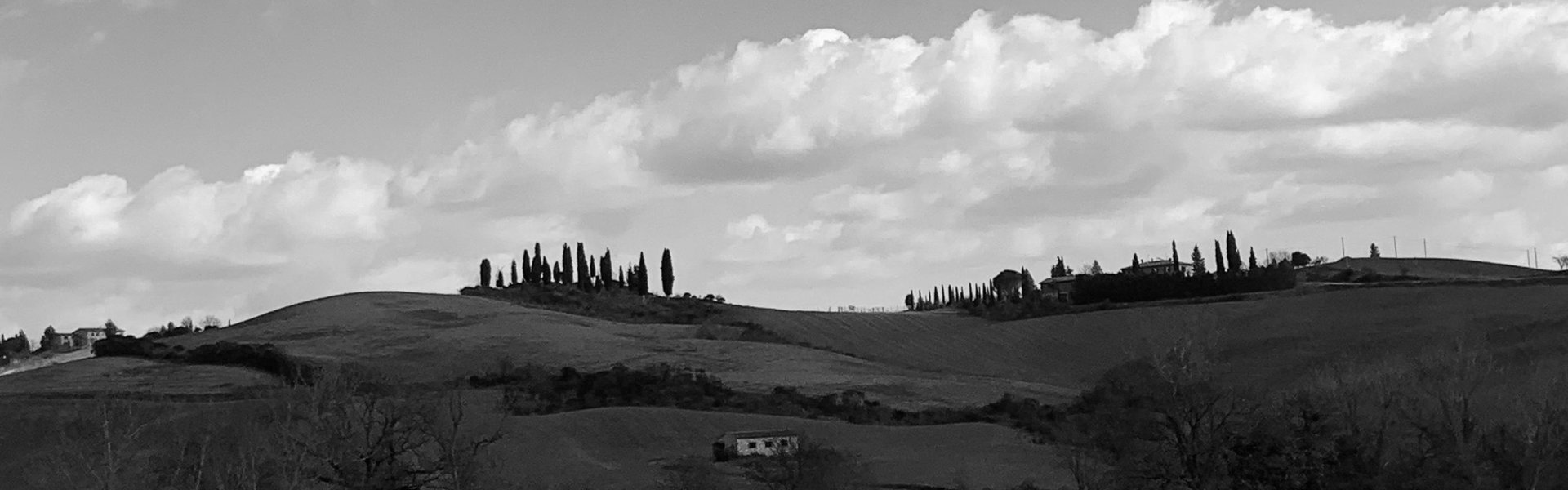
When I arrived there with my father, the local farmers described Podere La Torre as a hillside known for its vipers, mushrooms, olive oil, and fragrant wine. At the top of the hill was a large stone farmhouse, and around it a thicket of brambles, broom, and holm oaks.
When I arrived in Montalcino, I was young. I traveled with my father in a white car, where our mutual desire for recognition expressed itself in a sequence of silences, smiles, and disagreements.
One day, as I gazed into the horizon, we came to a place of intense light; atop a hill stood a ruin, surrounded by pasture and patches of broom, brambles, and holm oaks. From the abandoned barn, we watched clouds drift by above us; my father and I were above the clouds, always together, with affection and with resentment.
Later, I learned that much life had unfolded in that ruin, and that a few years before, it had housed a sharecropper family of eighteen people; the traces they left behind were soot-stained oven walls, a mingled smell of stable and flour, stray stalks of straw in the yard, and three large cherry trees; around the hill, the wind bent the broom over once-cultivated land.
When my father decided to buy the farm, I didn’t believe that place would become a part of my life, but that ruin—with its stones, white plaster, and wind I imagined also white—soon captured me. An unexpected seduction of colors began with the pink-blue of sunset lighting faces with a glow I had never seen, then the blue of nights bright with stars, and finally the dawn light unveiling every flower and bud in the wonder of their shapes.
Beyond beauty, that place, bathed in light and open horizon, resonated with my sense of space—an infinite space rich in possibility, life, and prospects for my ways of being. At that time I had no real awareness of who I was and drifted in a sea of outlines and centers; my idea of space was felt in my wide stride—sometimes hesitant, sometimes bold, as if in my step I conveyed the confusion of ease and shyness in one coming into being; my mind still sailed in a kind of unconsciousness, and with the clouds I watched from above, I shared passing shapes, movement, and changeability.
Perhaps my tendency to have my head elsewhere didn’t fit with the farm world ruled by necessity and seasons, but with its people, I shared the same language; in fact, I too came from an agricultural background and spoke a language rooted in times of harvest, sowing, and waiting.